

United States Durable Medical Equipment Market Overview
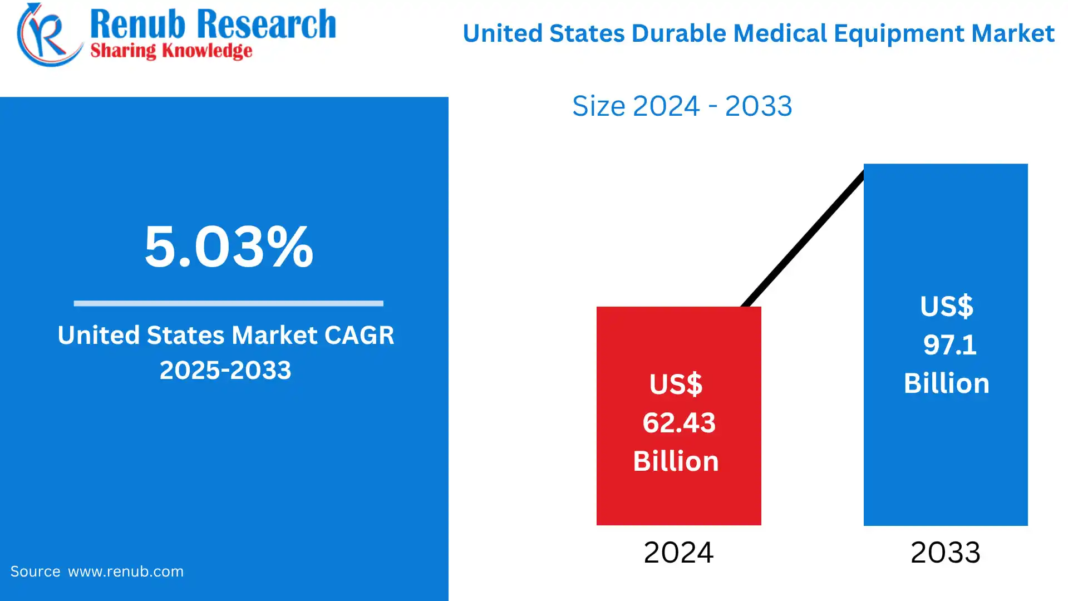
The United States Durable Medical Equipment (DME) market is currently navigating an exciting landscape characterized by sustained and resilient growth. Supported by demographic shifts, the increasing prevalence of chronic diseases, and a trend toward home-based care, this market is projected to expand significantly in the coming years. According to Renub Research, it was valued at approximately US$ 62.43 billion in 2024, with forecasts suggesting it could reach US$ 97.10 billion by 2033, corresponding to a CAGR of 5.03% from 2025 to 2033.
What is Durable Medical Equipment?
Durable Medical Equipment encompasses a wide range of physician-prescribed medical products tailored for long-term usage. These items enable patients to manage illnesses, recover from surgical procedures, or live independently despite disabilities. Common examples include wheelchairs, walkers, respiratory equipment, blood glucose monitors, hospital beds, nebulizers, and suction pumps. Unlike disposable medical supplies, DME products are built for durability and repeated use, ensuring safety and increased therapeutic benefits.
DME plays a crucial role in the U.S. healthcare ecosystem. It reduces hospital stay durations, lowers overall healthcare costs, and significantly enhances the quality of life for patients. Coverage from Medicare, Medicaid, and many private insurers allows for more widespread access to these essential devices, making the market intricately linked to reimbursement policies and regulatory frameworks.
Growth Drivers in the United States Durable Medical Equipment Market
Aging Population and Rising Chronic Disease Burden
The aging U.S. population is one of the strongest catalysts for the growth of the DME market. Nearly 77 million baby boomers are transitioning into senior age groups, leading to increased demand for mobility aids, respiratory devices, and monitoring equipment. Older adults are particularly vulnerable to conditions like arthritis, osteoporosis, cardiovascular diseases, diabetes, and various mobility impairments—all of which often necessitate long-term use of specialized equipment.
Simultaneously, more than half of U.S. adults live with chronic diseases, which drives demand for products such as glucose monitors, oxygen concentrators, CPAP devices, and infusion pumps. With a heightened focus on managing diseases regularly rather than just episodic treatments, DME becomes essential in allowing patients to maintain their independence and quality of life.
Expansion of Home Healthcare Services
The home healthcare paradigm is radically reversing traditional methods of medical service delivery in the United States. With rising hospital costs, shorter inpatient stays, and a stronger preference for home-based recovery among patients, the demand for DME is skyrocketing alongside this trend.
Durable equipment such as hospital beds, oxygen therapy devices, nebulizers, and mobility aids have become essential for effective treatment at home. The integration of Medicare and Medicaid reimbursement support for home healthcare has simultaneously improved accessibility and affordability, promoting greater adoption of DME. The growth of remote monitoring technologies, portable devices, and telehealth services is expected to propel the demand for DME solutions even further through 2033.
Technological Advancements in Medical Devices
Innovation is revolutionizing the durable medical equipment landscape. Today’s DME products are being designed to be lighter, smarter, and more patient-centered than ever before. Contemporary examples include smart wheelchairs equipped with navigation assistance, Bluetooth-enabled glucose meters, and battery-powered suction pumps that are easy to transport.
The ability of these devices to integrate with smartphones, cloud platforms, and telehealth services allows for real-time data sharing between patients, caregivers, and healthcare providers. These innovations not only boost treatment adherence but also enhance clinical outcomes. Coupled with advancements in materials for improved comfort and durability, the push for technology-driven solutions is leading manufacturers to increase their research and development investments significantly.
Challenges Facing the United States Durable Medical Equipment Market
High Costs and Reimbursement Limitations
Despite robust demand, the DME market wrestles with challenges, notably high upfront costs and complex reimbursement processes. Although many devices qualify for coverage under Medicare and Medicaid, the approval timelines, extensive documentation requirements, and reimbursement caps can create barriers to entry that delay patient access.
Out-of-pocket expenses for more advanced or non-covered models can further deter adoption, particularly among low-income individuals and the elderly. Also, frequent shifts in reimbursement policies and coding guidelines contribute to uncertainty in revenue, complicating long-term planning for suppliers and impeding market entry for smaller companies.
Regulatory Compliance and Quality Standards
Strict regulatory oversight governs the U.S. DME industry, primarily by agencies such as the FDA and CMS. Manufacturers are required to adhere to rigorous standards regarding product safety, labeling, quality control, and post-market surveillance.
Regulatory delays, product recalls, or compliance failures can have significant repercussions, disrupting operations and potentially tarnishing brand reputations. Smaller manufacturers, in particular, often struggle with the balancing act of managing regulatory costs while driving innovation and maintaining price competitiveness, making this a perpetual challenge across the sector.
Product-Specific Market Insights
United States Medical Wheelchairs Market
The market for medical wheelchairs is seeing steady growth, driven by an aging demographic and rehabilitation needs. Both manual and powered wheelchairs are widely utilized in home care, hospitals, and long-term care facilities. Technological enhancements such as lightweight frames, power tilt features, and advanced joystick controls have elevated user comfort and mobility.
Insurance coverage through Medicare and Medicaid plays a critical role in making these essential devices accessible. At the same time, customization options are increasingly recognized as vital for enhancing patient satisfaction.
United States Commodes and Toilets Market
Adaptive commodes and toilet aids are crucial for maintaining dignity and independence among elderly and mobility-impaired individuals. The growth of this segment is strongly linked to the trend of aging in place and the expansion of home healthcare services.
Products such as bedside commodes, rolling commodes, and adjustable designs are in high demand across a variety of care settings, including homes, hospitals, and nursing facilities. Innovations aimed at improving hygiene, adjustability, and ease of cleaning are contributing to consistent market expansion.
United States Blood Sugar Monitoring Equipment Market
The market for blood sugar monitoring equipment is experiencing rapid growth, largely driven by the high prevalence of diabetes. Devices such as glucometers and continuous glucose monitors (CGMs) are essential for effective daily disease management.
Modern monitoring systems provide real-time alerts, smartphone integration, and data analytics, significantly improving patient compliance and clinical outcomes. Factors such as insurance coverage and the adoption of digital healthcare models continue to bolster demand for advanced glucose monitoring solutions.
United States Nebulizers Equipment Market
Nebulizers play an essential role in treating respiratory conditions such as asthma, Chronic Obstructive Pulmonary Disease (COPD), and cystic fibrosis. Increased air pollution and heightened awareness of respiratory health following the pandemic are fuelling growth in this market segment.
The rise in home-based nebulizer usage is being accelerated by the expansion of telehealth services and earlier hospital discharges. Portable, battery-powered nebulizers are particularly popular for their convenience, enhancing treatment adherence.
United States Suction Pumps Equipment Market
Suction pumps are essential tools in surgical, emergency, and home care settings for airway clearance and fluid removal. Growth in this segment is propelled by increasing surgical volumes, emergency response requirements, and rising instances of chronic respiratory conditions.
Technological improvements focusing on noise reduction, suction precision, and portability are expanding the utility of suction pumps beyond hospitals into ambulatory settings and home care environments, supporting long-term market growth.
End-User Analysis
Hospitals Durable Medical Equipment Market
Hospitals remain substantial consumers of durable medical equipment, reliant on a diverse array of devices for inpatient, outpatient, and critical care. Investments in smart beds, mobility aids, ventilators, and infection-control-friendly equipment continue to rise as hospitals modernize their infrastructures to ensure patient safety and efficiency.
Purchasing strategies in this segment often revolve around bulk agreements and long-term supplier partnerships, emphasizing the need for trusted relationships in procurement processes.
Home Healthcare Durable Medical Equipment Market
Home healthcare has emerged as the fastest-growing end-user segment in the U.S. DME market. Products such as oxygen concentrators, hospital beds, glucose monitors, and mobility aids are increasingly prescribed for home use.
Patient preference for recovery in a home setting, alongside value-based care models and reimbursement support, plays a pivotal role in accelerating the adoption of DME solutions. Lightweight, compact, and user-friendly devices are preferred, reinforcing strong growth momentum in this area.
State-Level Market Insights
California Durable Medical Equipment Market
California is at the forefront of the U.S. DME market, bolstered by its significant elderly population and advanced healthcare infrastructure. Urban areas like Los Angeles and San Francisco drive demand for cutting-edge equipment, while rural regions focus on mobile and home-based solutions to meet care needs.
New York Durable Medical Equipment Market
New York’s DME market thrives due to its dense population, high rates of chronic diseases, and extensive networks spanning hospitals and home care providers. Strong Medicaid coverage alongside a focus on post-acute care and health equity supports sustained demand across both urban and suburban areas.
Competitive Landscape and Key Players
The U.S. Durable Medical Equipment market is moderately consolidated, with several leading companies focusing on innovation, distribution expansion, and regulatory compliance. Some of the key players include Invacare Corporation, NOVA Medical Products, Inogen, Inc., Thermo Fisher Scientific Inc., Abbott, Medtronic, Baxter, B. Braun SE, Boston Scientific Corporation, and BD.
These companies are evaluated on critical dimensions such as company overview, leadership, recent developments, SWOT analysis, and revenue performance. Their strategic positions provide insight into ongoing trends within the evolving U.S. healthcare landscape.
The Durable Medical Equipment market in the United States is not merely a sector of medical devices; it is a comprehensive ecosystem crucial for improving patient health outcomes, enhancing quality of life, and promoting cost-effective care. As it evolves, it holds immense potential for innovation, accessibility, and improved healthcare delivery across the nation.