

Understanding the Stair Lifts Market: Trends, Drivers, and Innovations
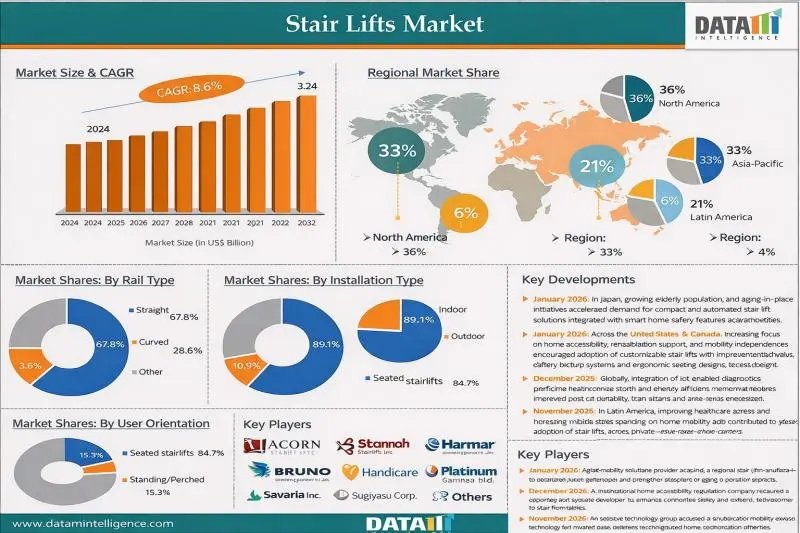
The stair lifts market is a rapidly expanding sector that focuses on providing mobility solutions for individuals facing mobility challenges. With a projected growth from USD 1.36 billion in 2024 to USD 3.24 billion by 2032, this market is expected to grow at a compound annual growth rate (CAGR) of 8.6% between 2025 and 2032. This significant growth can be attributed to various global trends and innovations aimed at enhancing the quality of life for seniors and those with physical limitations.
The Rising Demand for Stair Lifts
An aging global population is a key factor driving demand for stair lifts. As more individuals reach advanced ages, the prevalence of mobility-related disabilities has increased, necessitating solutions that allow individuals to remain in their homes. Many seniors prefer to “age in place,” seeking modifications to their living spaces that promote independence while minimizing risks, particularly falls associated with stair usage.
Stair lifts, which provide safe and reliable vertical mobility within homes or commercial settings, are essential in this regard. By reducing the hazards associated with stairways, these devices significantly enhance accessibility in both residential and commercial buildings.
Technological Advances Shaping the Industry
Technological innovations are revolutionizing the stair lift market, making products more appealing to a diverse range of users. Modern stair lifts are now equipped with features such as:
- Smart Controls: This includes remote controls and smartphone integration, allowing users to operate lifts from a distance.
- Energy-Efficient Motors: Quieter and more efficient motors enhance the overall user experience.
- Customizable Seating Options: Adjustable designs cater to individual needs, enhancing comfort and safety.
- Safety Features: Enhanced sensors and safety protocols reduce risks during operation.
These advancements are fostering broader acceptance of stair lift solutions, contributing to growth in both residential and commercial sectors.
Market Drivers
Several factors are propelling the growth of the stair lifts market:
-
Aging Population: As mentioned earlier, the increasing number of seniors places heightened demand on mobility solutions designed specifically for their needs.
-
Aging-in-Place Preference: Many seniors prefer to remain in their homes as long as possible, prompting the demand for solutions that facilitate this lifestyle.
-
Government Initiatives: Supportive reimbursement frameworks and funding programs aimed at mobility solutions are encouraging investment in stair lift technologies.
-
Home Healthcare Services Expansion: An increase in home healthcare services has fostered an environment conducive to the adoption of stair lifts.
Regional Market Insights
The stair lifts market is diverse and varies by region:
-
North America: Capturing a significant 36% market share, this region benefits from high awareness of mobility solutions and a large elderly population.
-
Europe: With a 33% share, Europe’s market is driven by favorable accessibility regulations and a growing demographic of seniors.
-
Asia-Pacific: Holding a 21% share, the Asia-Pacific market is bolstered by rapid urbanization and improving healthcare infrastructures.
-
Latin America: Although a smaller 6% share is held here, rising awareness of mobility assistance products is gradually pushing growth.
-
Middle East & Africa: Representing 4% share, this region is experiencing growth due to improving healthcare access and growing elderly care services.
Key Developments in the Industry
Recent developments underscore the vibrancy of the stair lifts market. For instance, initiatives like the integration of IoT-enabled features and predictive maintenance alerts are gaining traction. This kind of smart technology improves user safety and product reliability, fostering greater confidence among consumers.
Significant mergers and acquisitions have also characterized the market. A mobility solutions provider recently acquired a stair lift manufacturer to enhance distribution capabilities, illustrating the industry’s consolidation trends aimed at expanding market presence.
User Orientation and Customization Trends
The market sees varying user preferences regarding stair lift types:
-
Seated Stair Lifts: Dominating the sector, these models are suitable for older adults and impaired users needing assured support.
-
Standing and Perched Stair Lifts: This segment is growing, particularly among users who may have limited flexibility or prefer a compact design.
Sustainable Practices in Stair Lift Production
The industry is also witnessing a shift towards sustainable practices. Manufacturers are exploring lightweight materials, energy-efficient designs, and adaptable aesthetics, responding to both environmental concerns and consumer preferences for modern living spaces.
Future Prospects of Stair Lifts
Looking ahead, the stair lifts market appears poised for robust growth, driven by continuous innovations and shifting consumer dynamics. Service enhancements such as rentals and comprehensive support programs are making mobility solutions more accessible and affordable, ensuring that the needs of an aging population are met effectively.
The focus on universal design principles and independent living is likely to continue catalyzing advancements in stair lift technologies, ensuring that they remain integral to improving mobility in diverse settings.