


Elderly Walker Market Size & Growth Analysis
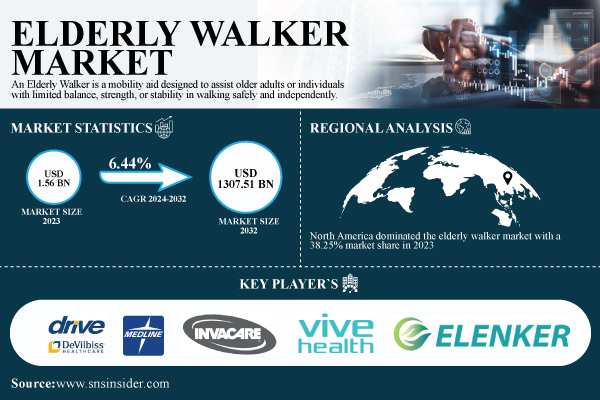
Austin, Oct. 07, 2025 (GLOBE NEWSWIRE) — The Elderly Walker Market is experiencing substantial growth, with its size valued at USD 1.56 billion in 2023. Projections indicate it will reach USD 2.73 billion by 2032, growing at a CAGR of 6.44% from 2024 to 2032. The driving forces behind this surge include the increasing global aging population and greater awareness of mobility impairments among seniors, which drives the demand for mobility aids. Moreover, innovations in walker design, incorporating ergonomic features and smart technologies, are enhancing user experiences and contributing significantly to market expansion.
Market Dynamics
The elderly walker market has seen steady growth in recent years, supported by demographic trends highlighted by the World Health Organization. By 2050, the population aged 60 and older is expected to reach 2.1 billion, leading to decreased mobility and increased fall risks among seniors. This scenario incentivizes the adoption of mobility-supporting devices.
While challenges persist, such as high costs and limited insurance coverage in lower-income regions, growing government healthcare expenditure and ongoing technological innovations continue to fuel market growth. The rise of home healthcare preferences has also led to improved accessibility, with direct-to-consumer sales channels playing a pivotal role.
Major Players in the Market
Several key players dominate the elderly walker market, each contributing unique products and advancements. Notable companies include:
- Drive DeVilbiss Healthcare (Nitro Euro Style Rollator Walker)
- NOVA Medical Products (GetGo Classic Rollator Walker)
- Medline Industries, Inc. (Premium Empower Rollator Walker)
- Invacare Corporation (Dual Release Walker)
- Hugo Mobility (Elite Rollator Walker)
These companies are not only focusing on product diversification but also on enhancing user experience through innovative designs.
Market Segmentation
By Type
The walker market can be segmented into Standard Walkers, Knee Walkers, and Rollators. In 2023, Rollators dominated the market with 55.13% share, owing to their enhanced functionality, simplicity, and increasing popularity among seniors. Unlike standard walkers, rollators come equipped with wheels, seats, and braking systems, facilitating greater mobility and convenience.
By End-Use
The end-use segmentation reveals that hospitals held 39.24% of the market share in 2023 due to the high volume of geriatric patients requiring mobility support for recovery and rehabilitation. However, the home care segment is expected to grow the fastest, exhibiting a 7.27% CAGR, fueled by a shift towards aging-in-place and preference for home healthcare services.
Regional Insights
In 2023, North America accounted for 38.25% of the elderly walker market share. The region’s strong position can be attributed to its aging population, substantial healthcare spending, and a well-established medical infrastructure. Meanwhile, the Asia Pacific region is anticipated to experience the highest growth rate, with a 7.54% CAGR from 2025 to 2032. This rapid growth can be linked to the region’s burgeoning aging population, enhanced healthcare infrastructure, and rising disposable income.
Recent Developments
A couple of noteworthy trends have emerged recently:
-
June 2024: Drive DeVilbiss Healthcare acquired Mobility Designed’s product line as part of its strategy to expand its medical equipment offerings. Co-founder Max Younger took on a key role as Senior Director of Industrial Design & Innovation, focusing on incorporating innovative designs into their products.
-
September 2024: NOVA Medical Products launched the Test Drive Center Certification, an initiative aimed at enabling retailers to provide in-store trial opportunities for their rollators. This initiative aims to eliminate stigma surrounding the use of mobility aids while enhancing customer experience through hands-on testing.
Exclusive Insights
The market analysis also unveils several unique selling propositions (USPs):
-
Aging Population & Mobility Impairment Metrics: This section delves into the growing elderly demographic and statistics on mobility impairment that influence the demand for assistive devices across various markets.
-
Adoption Trends by Region: Insight into key regions with strong adoption rates and emerging opportunities for elderly walkers.
-
Sales Volume Forecast (2020–2032): Evaluates long-term demand trends and regional growth trajectories, providing valuable insights for strategic planning.
-
Healthcare Expenditure Insights: Discusses spending patterns on assistive mobility devices across regions, shedding light on purchasing potential and policy support.
-
Regional Market Opportunities Index: Identifies high-growth geographies by integrating demographic, economic, and healthcare spending indicators, thus enhancing market intelligence.
Conclusion
In summary, the elderly walker market is on an impressive trajectory, driven by demographic shifts, technological advancements, and evolving consumer preferences. With various players innovating to meet the needs of an aging population, the future holds promising prospects for mobility aids that enhance quality of life for seniors around the world.