
The Mobility Scooter Debate in Alberta: A Call for Change
Background on Mobility Scooters in Olds
A significant debate is unfolding in Alberta over the use of mobility scooters, specifically in the town of Olds, which lies about 90 kilometers north of Calgary. With a population of around 9,000, Olds is home to residents who rely on mobility scooters for independence and mobility. Recently, however, a bylaw enforcement crackdown has led to heightened tensions and anxiety among these residents.
Jennifer Clarke’s Struggle
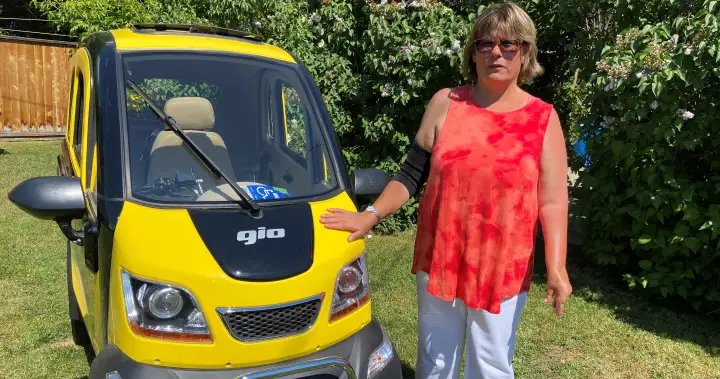
Jennifer Clarke, a long-time resident of Olds, embodies the challenge faced by many. Living with cerebral palsy, she has utilized her enclosed electric scooter to navigate the town freely for six years. That changed dramatically in June 2024 when a bylaw officer stopped her while she was using her scooter. Clarke was informed that her mobility scooter was not permitted on sidewalks, streets, or pathways. “I asked, ‘Where am I allowed to use my mobility aid?’ They said in my backyard,” she recounted.
This interaction struck a painful chord for Clarke: “I’m heartbroken. I feel sick. It’s taken away my independence.” Since this incident, her mobility scooter has been confined to a shed, a poignant symbol of lost freedom.
The Wider Implications
Clarke’s experience is not isolated. Another resident, Bob Fisher, reported a similar encounter where he was warned not to use his scooter on the roads. “The bylaw officer let me take it home and said, ‘If I catch you I’ll give you a $500 ticket,’” Fisher said. His incredulity reflects a growing sentiment among residents that the enforcement of such prohibitions is unnecessary and disproportionately harsh. “It’s not like we’re running into each other or running over somebody,” Fisher added.
Both Clarke and Fisher’s stories highlight the potential impact of these bylaw changes on community members who depend heavily on their mobility devices for basic transportation.
Local Government Response
The situation took a political turn when Nathan Cooper, the MLA for Olds-Didsbury-Three Hills, stepped in. Cooper clarified that existing laws do not accommodate the use of Clarke’s type of mobility device on public roads. A pilot project initiated by the transportation minister permits communities to request exemptions for using such devices on sidewalks, but the town of Olds has yet to engage with this option effectively.
Local government spokesperson Jillian Toellner explained that there is currently no designated bylaw specifically addressing scooter use. “We received complaints about prohibited vehicles driving on roads and investigated accordingly,” she stated. According to Toellner, while individual clarifications were being awaited from Alberta Transportation, the town has shown a willingness to engage with the community’s needs—a positive sign in a complex situation.
Advocacy and Community Action
In response to these developments, Clarke has taken the bold step of launching a human rights complaint against the town of Olds. “It’s not fair because I’d want someone to stick up for me too,” she declared. She emphasizes that this issue transcends her own experience—fighting for the rights of all seniors and people with disabilities is paramount.
Advocates have rallied around the cause; a petition has gained traction, aiming to modify regulations governing where mobility scooters can be used. This grassroots effort is indicative of a community pressing for change amidst a backdrop of bureaucratic stagnation.
The Road Ahead
The ongoing discussions within Alberta Municipalities add another layer to this dynamic. A motion was passed last fall advocating for legislative changes to the Traffic Safety Act, allowing for the authorized use of golf carts and, by extension, potentially mobility scooters on specific roadways. As Clint Neufeld, the director of policy and advocacy with Alberta Municipalities, indicated, they are awaiting responses from the province regarding enabling changes that could benefit those in need.
As Olds navigates this contentious issue, the conversations sparked by Clarke, Fisher, and their advocates could pave the way for greater inclusivity and freedom for individuals reliant on mobility aids. The outcome of these discussions could reshape the future not just for Olds, but also for communities across Alberta grappling with similar challenges.