
The Lift Mystery: Why Older HDBs Skipped Floors
If you’ve ever wondered why lifts in older HDB blocks seem to have a peculiar habit of skipping floors, you’re not alone. Generations of residents have climbed those extra flights of stairs, often wondering if their lift had somewhere better to be. But what’s the story behind this architectural quirk? Let’s dig into the history and the decisions that led to these unique designs.
Historical Design Choices & Constraints
To understand why older HDB lifts don’t stop at every floor, we need to journey back to Singapore’s early housing developments. During the HDB’s initial boom in the 1960s to 1980s, the emphasis wasn’t on luxury convenience; it was about addressing urgent housing needs. The primary goal was simple: shelter as many families as possible with limited resources.
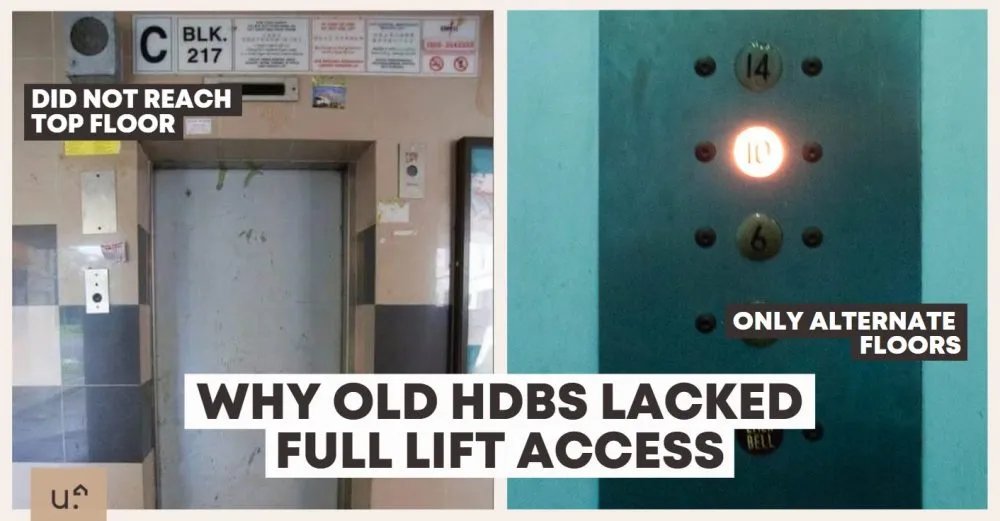
In this context, some tough trade-offs had to be made regarding lift accessibility. Full-floor access lifts were deemed a luxury, akin to having a dishwasher at home in that era. Implementing lifts that stopped at every floor required more space and more sophisticated machinery, which meant more money. Consequently, HDB opted for intermediate landing designs: lifts that only stopped on alternate floors or selected configurations that struck a balance between cost and functionality.
Interestingly, there’s a theory suggesting that lifts skipping floors reduced corridor foot traffic, aiming for quieter living spaces. Whether this was intentional planning or simply budget constraints is a topic for historians to debate.
Why Lifts Didn’t Reach the Very Top or Every Floor
A lesser-known fact is that some early HDB blocks physically could not support lift shafts that extended to the highest floors. This was due to inherent structural limitations. But, as always, cost outweighed convenience.
Fast-forward to today: most older blocks have been upgraded through the Lift Upgrading Programme (LUP). However, some buildings, like Block 291 in Choa Chu Kang and Block 4 in Sago Lane, are still without full lift access. The reticence isn’t a matter of oversight; rather, retrofitting full-height lifts often turns out to be either physically impossible or financially impractical.
Imagine the costs: in some extreme cases, retrofitting could exceed $200,000 per household. At that price, it could feel like constructing a lift made of gold!
The “Even or Odd Floor” Phenomenon
Another oddity many Singaporeans remember is encountering “even- or odd-floor only” lifts. This bizarre lift design meant that residents in certain blocks—especially those constructed from the 1970s to the early 1990s—would only have access to either all odd-numbered or all even-numbered floors.
As a result, many would have to tackle a set of stairs after disembarking the lift. HDB has never explicitly explained this phenomenon, but the logic behind it likely ties into the same concerns that shaped the construction of HDB buildings in general:
- Cost Efficiency: Fewer lift landings meant lower construction costs.
- Operational Efficiency: Reducing the number of stops minimized wear and tear on the lift mechanisms.
- Structural Constraints: Older blocks had narrower lift shafts or mid-landings, rendering it challenging to add doors on every floor.
- Staged Lift Designs: Many older lifts were not built to accommodate multi-door systems without significant retrofitting.
These constraints reflect the architectural philosophies of the time: notably, functionality and cost control, with accessibility considerations coming much later.
Why Some Blocks Still Haven’t Been Upgraded
Despite decades of upgrades, certain older HDB blocks still lack full lift access. Some retrofitting options like stair lifts were deemed unsafe, as they could obstruct escape routes during emergencies. HDB even considered more innovative solutions—including machine room-less lifts, home lifts, and even bubble-style external lifts. Unfortunately, space constraints often made these fancy options unviable.
Rather than demolishing entire blocks, HDB introduced the Lift Access Housing Grant (LHG), providing up to $30,000 for families who need barrier-free access and wish to relocate to a flat with direct lift access. While not a complete solution, it offers some assistance for those affected.
Impact on Residents
For residents in blocks without full lift access, this is more than just a minor inconvenience; it’s a daily reality. Imagine returning from the market with groceries or climbing stairs after a long day—each trip home quickly becomes a workout, a contrast starkly felt by those with unhindered lift access.
This struggle is even more acute for the elderly or those with mobility challenges, where a simple flight of stairs can feel like a daunting mountain. Fortunately, some residents have benefited from the Lift Access Housing Grant and successfully transitioned to flats with direct lift access.
Despite improvements, approximately 2,000 flats remain in this limbo, lacking same-level lift access. While that number may seem small relative to the entire public housing landscape, for those affected, it represents a significant part of their everyday lives.
What HDB & MND Are Doing to Help Residents
The good news is that the government is addressing these ongoing concerns. Since 2001, the Lift Upgrading Programme has transformed over 5,000 HDB blocks, improving access for thousands of residents.
For those blocks where retrofitting is particularly complex, the Ministry of National Development (MND) is exploring innovative technologies like machine room-less lifts, hoping these advancements will offer solutions even for the most resistant older blocks.
Additionally, MND actively encourages residents to reach out directly to discuss tailored solutions specific to their circumstances.
Understanding Why Old HDBs Did Not Have Full Lift Access
In essence, the narrative surrounding lift access in older HDBs is a story of prioritization: balancing costs against coverage, structural realities against societal needs. What made perfect sense in the 1960s and 70s—skipping floors for savings and working within narrow shafts—has translated into significant challenges for today’s residents.
However, the ongoing exploration of innovative lift technologies and supportive housing grants signals an earnest effort to make public housing more accommodating and lessen the burden of those extra stairs. The narrative continues as Singapore navigates the complexities of its evolving urban landscape.