

Walking Aid Market Size and Share Forecast Outlook (2025 to 2035)
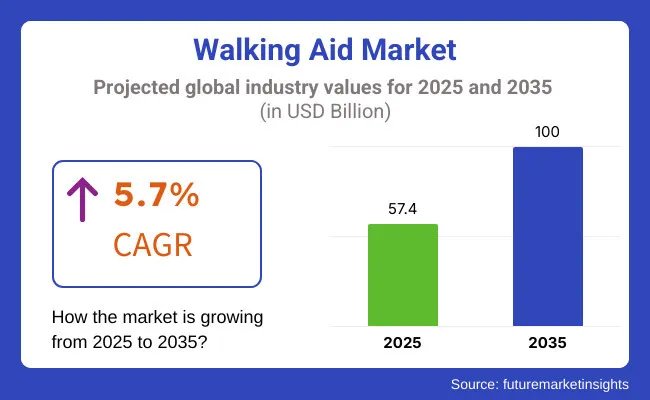
The global walking aid market is set to experience robust growth over the next decade, with an estimated compound annual growth rate (CAGR) of 5.7% from 2025 to 2035. This growth is driven by a variety of factors including an increasing geriatric population, greater awareness about assistive devices, and advancements in walking aid technologies. Walking aids like crutches, canes, walkers, and rollators are essential for enhancing independence and mobility for individuals with disabilities or age-related conditions.
Technology Revolutionizing Walking Aids
Recent innovations have transformed the walking aid sector. Smart walking aids equipped with sensors, GPS tracking, and ergonomics are making these devices more efficient and user-friendly. The integration of technology helps caregivers monitor patients, ensuring their safety and improving the overall quality of life. Government initiatives that promote the use of assistive devices, favorable reimbursement policies, and increasing focus on fall prevention are also significant contributors to market expansion.
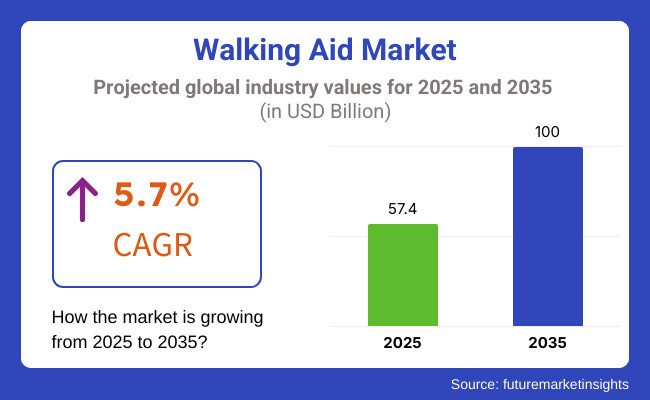
Despite these positive trends, the market faces challenges such as high costs of advanced mobility aids, limited access in developing regions, and societal stigma surrounding the use of mobility aids. Nevertheless, the walking aid market is projected to reach USD 100 billion by 2035.
Regional Trends Shaping the Industry
North America
North America is poised to dominate the walking aid market, bolstered by a well-established healthcare infrastructure and a rapidly aging demographic. The rise in conditions such as arthritis, osteoporosis, and other musculoskeletal disorders is triggering an increased demand for mobility aids. Government initiatives, public health programs, and insurance coverage further enhance market growth, creating numerous opportunities for manufacturers to develop customized and ergonomically designed solutions.
However, the high costs associated with advanced walking aids pose a challenge, particularly for low-income populations. The rise of e-commerce and direct-to-consumer sales models may help alleviate these issues, making mobility aids more accessible.
Europe
The European market is experiencing sustainable growth fostered by an aging population and favorable healthcare policies. Key countries like Germany, France, and the UK are at the forefront of research and development in smart mobility aids. The rising demand for rollators and smart walking sticks that enhance stability is evident.
Moreover, government-funded subsidies make walking aids more affordable, thus increasing their accessibility. Yet, strict reimbursement policies and varying healthcare regulations among European countries present challenges for manufacturers.
Asia-Pacific
In the Asia-Pacific region, countries such as China, India, and Japan are witnessing significant market growth fueled by increasing awareness and better access to rehabilitation services. Rapid urbanization and improved healthcare coverage in developing economies are facilitating access to mobility aids, particularly in urban areas.
However, market growth could be hampered by affordability issues and a general lack of awareness in rural regions. Government initiatives aimed at elderly care are encouraging manufacturers to develop cost-effective and advanced mobility solutions.
Challenges and Opportunities
Challenges
While there are numerous growth opportunities, several obstacles could restrict market expansion. The high costs of innovative mobility solutions can prevent low-income groups from accessing walking aids. Additionally, societal attitudes toward mobility aids may deter usage, particularly among younger individuals with disabilities.
Further complicating matters, regulatory complexity and the presence of counterfeit products in emerging markets can undermine consumer confidence. Additionally, alternative solutions like physical therapy and robotic exoskeletons could offer competition in the mobility aid market.
Opportunities
On the flip side, there’s an upward trend for innovative assistive technologies that presents attractive growth opportunities. Smart walking aids featuring GPS tracking and AI analytics are gaining traction, and rising healthcare spending coupled with supportive government initiatives can assist in broadening market access.
The shift toward direct-to-consumer sales through online platforms has enhanced product accessibility, and partnerships between healthcare providers and manufacturers are driving awareness campaigns. The growing demand for customized mobility solutions is also expected to lead to innovative products tailored to diverse consumer needs.
Industry-Specific Highlights
-
Advancements in Smart Walking Aids: Innovations such as AI-driven technologies are enabling caregivers to monitor movement patterns, significantly enhancing patient safety.
-
Growth of Lightweight and Ergonomic Designs: Manufacturers are developing foldable and adjustable walking aids using new materials like carbon fiber to enhance comfort.
-
Integration of Sustainable Materials: There’s a notable shift towards using eco-friendly materials in production, focusing on sustainability alongside efficiency.
Emerging Trends
-
Wearable Technology in Mobility Assistance: Wearable tech enables real-time health monitoring and enhances rehabilitation outcomes by analyzing user’s movements.
-
Increasing Adoption of 3D Printing: Customization through 3D printing technology is on the rise, allowing users to obtain tailor-made walking aids based on their unique physical attributes.
Brief Market Overview
The market for walking aids has seen consistent growth from 2020 to 2024 due to increasing awareness and the aging population. Factors such as innovations in materials, ergonomic designs, and smart features are considerably enhancing user safety and experience.
Looking at the forecast for 2025 to 2035, we can expect significant advancements driven by AI and IoT. Authorities are likely to enforce stricter safety standards, and there will be a notable shift toward using sustainable materials in manufacturing.
Country-Wise Analysis
United States
The U.S. is experiencing a surge in walkers and mobility aids due to a significant elderly population. Conditions like arthritis affect a considerable percentage of adults, creating demand for mobility assistance.
Germany
Germany’s market is buoyed by an established healthcare system and innovative products. Despite regulatory challenges, the presence of major manufacturers is beneficial for market growth.
China
China is witnessing rapid growth in the walking aid sector, driven by demographic changes and local manufacturing. However, regional healthcare discrepancies may pose challenges.
India
India’s market is expanding due to government initiatives and increasing healthcare access. The economic barriers in rural areas still pose challenges for widespread adoption.
Brazil
In Brazil, an aging population presents ample opportunities for growth, despite underlying economic disparities and varying healthcare access.
Walking Aid Market Outlook
Segment Outlook by Product
- Rollators are the leaders due to their advanced features, driving demand significantly among elderly and post-operative patients.
- Walkers and Gait Trainers play essential roles in rehabilitation, particularly for patients recovering from severe ailments.
Technology Trends
- Automated Walking Aids are emerging to provide dynamic support, while Manual Walking Aids remain vital for their affordability and simplicity.
Competitive Outlook
The walking aid market is increasingly competitive, with established companies like Invacare Corporation and Drive DeVilbiss Healthcare leading the charge. Innovation and user-friendly designs are key strategies being employed by top vendors to capture market share.
Market Share Analysis by Company
Companies like Invacare, Drive DeVilbiss, and Sunrise Medical dominate the market, focusing on ergonomic designs and advanced materials to meet consumer needs.
This competitive landscape, coupled with demographic shifts and increasing health awareness, suggests that the walking aid market is not just set for growth, but also transformation in the coming years.